ARIA Policy · ARIA Billing · ARIA Claims
How KGA ARIA works, in three screens
This is a walkthrough of the real application — not mockups — using a synthetic demo account (Henderson Property Management LLC). It shows how one commercial account moves from policy to billing to a claim, with governance built into every step. No sign-in required, nothing here calls the live application.
Status: Demo-operational · synthetic data only. Not a claim of a live customer deployment.
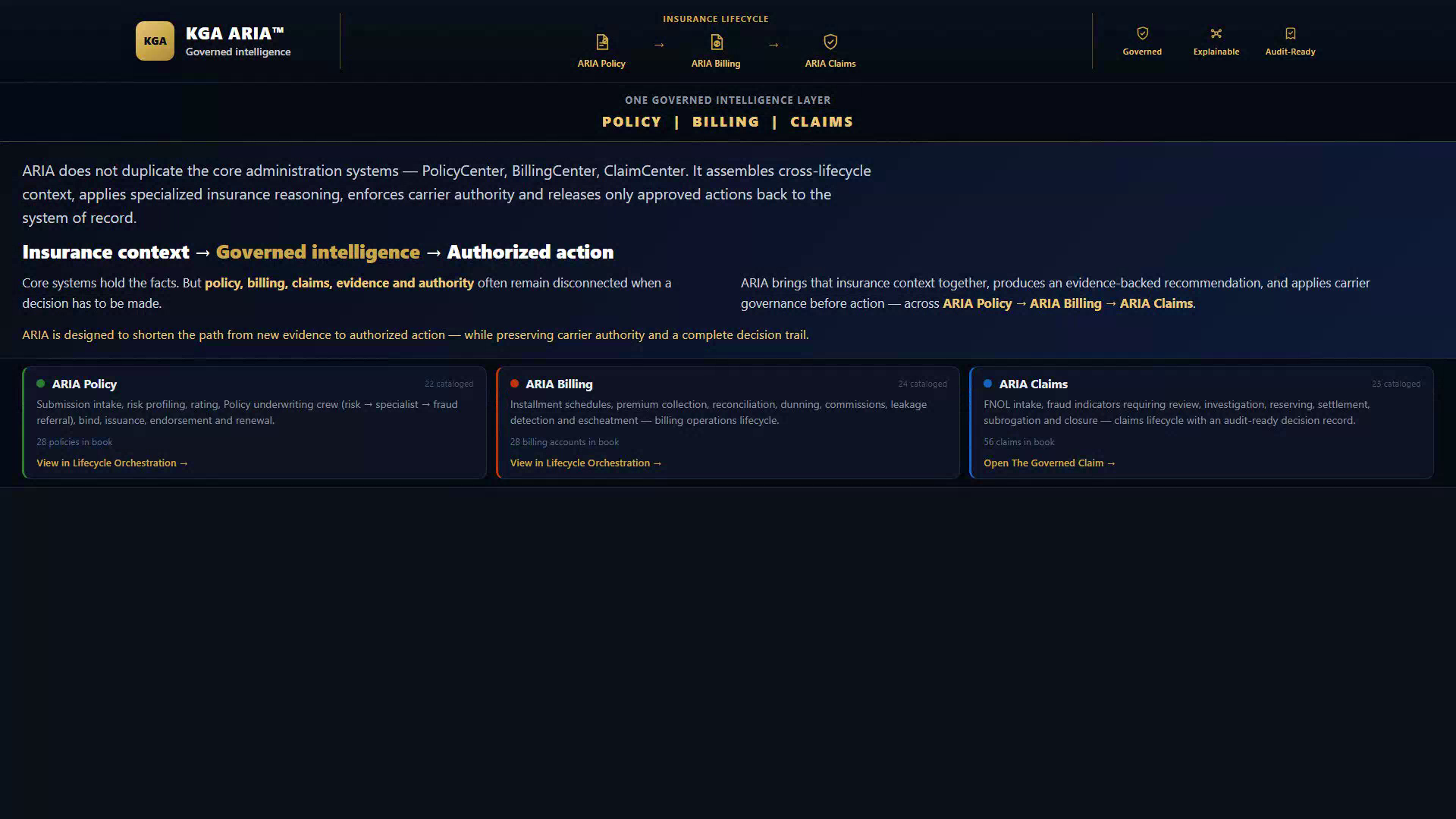
1. One governed intelligence layer across Policy, Billing, and Claims
The Command Center is the entry point: 22 cataloged Policy capabilities, 24 Billing, 23 Claims. ARIA does not duplicate the core administration systems (PolicyCenter, BillingCenter, ClaimCenter) — it assembles cross-lifecycle context, applies specialized insurance reasoning, enforces carrier authority, and releases only approved actions back to the system of record.
2. One account, one thread, stage by stage
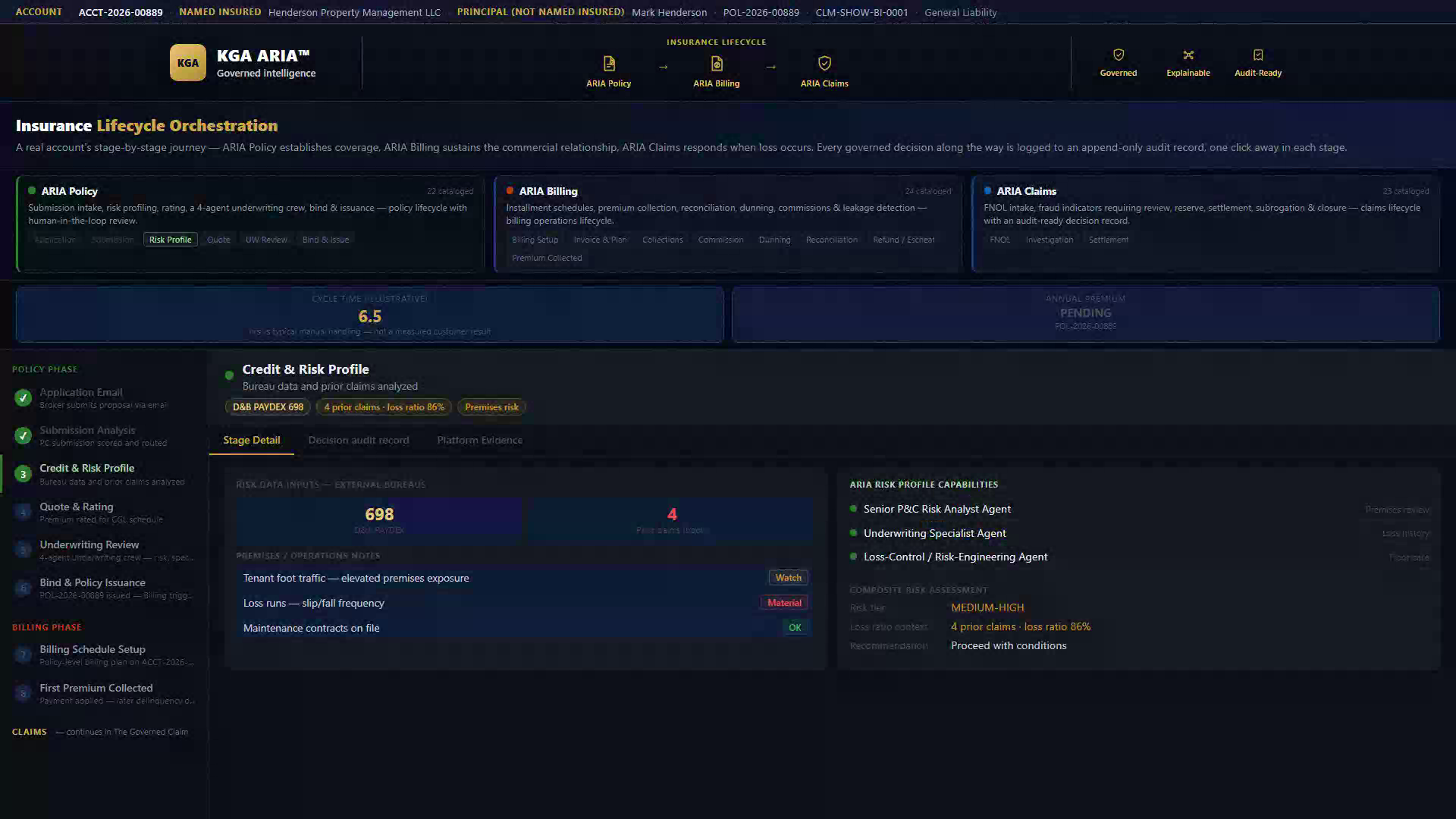
Lifecycle Orchestration follows a real account's stage-by-stage journey — application, risk profiling, underwriting review, bind and issuance, billing setup, and on into claims — with every governed decision logged to an audit record one click away at each stage. The risk profile shown here (D&B PAYDEX score, prior claims, premises risk notes) reflects the deterministic scoring behind the recommendation, not just a model's guess.
3. When a claim comes in, the same account context carries through
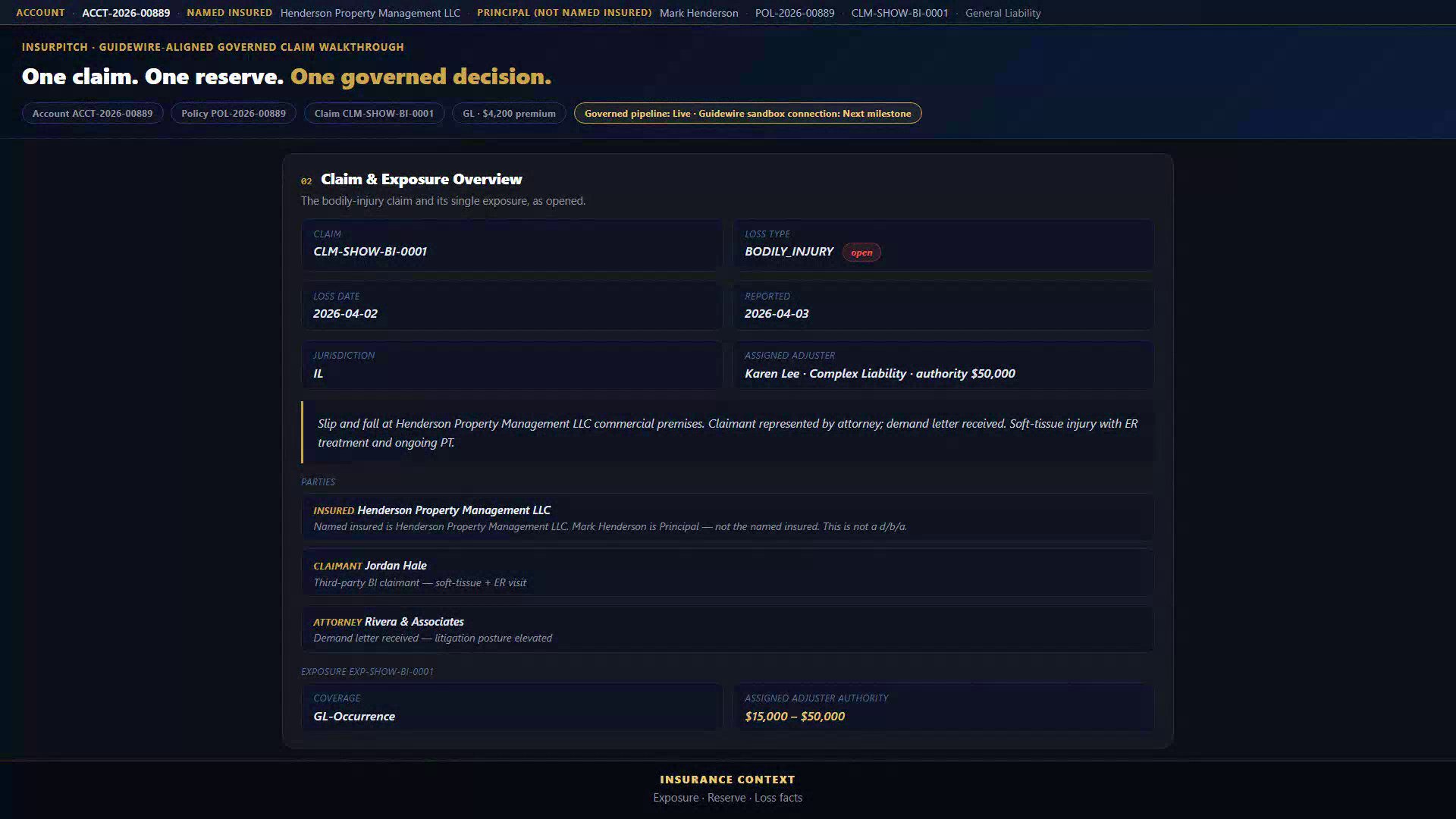
A claim on the same account doesn't start from zero — named insured, policy, coverage, and prior context are already there. This view shows a bodily-injury claim's exposure overview: loss facts, parties, coverage, and the assigned adjuster's authority range — the same information a human reviewer needs to make a governed reserve decision, with the reasoning attached rather than a number alone.
Enterprise-grade by architecture
Not a claim — a design. Three things built into the platform, not bolted on:
- Governance & security — PostgreSQL row-level security enforced at the database layer, not just application code. Every governed decision is hash-chained (SHA-256) into a tamper-evident audit trail. Human approval required before any high-impact action executes.
- Insurance domain depth — Deterministic underwriting appetite engine (hard-stop / refer / in-appetite) enforced independently of AI reasoning. Coverage-to-peril matching against the policy's coverage schedule, with reservation-of-rights draft generation. Reserve movement classified as first evaluation, expected development, or anomalous.
- Technical architecture — Deterministic rules underneath, AI reasoning in the middle, governance wrapping both — an AI-generated recommendation can never override an enforced rule. Coexistence-first: advisory mode needs no write-back to your core system to start.
Anthropic Claude is the current live model client. Live Guidewire sandbox write-back is pending credentials. Azure Marketplace listing is live; AWS and Google Cloud marketplace listings are not live. Krishcon is not SOC 2 certified. Briefing: book a product briefing or info@krishcons.com (typically within two business days).